Our craft
Letterpress
What letterpress is
Letterpress is printing by pressing an inked plate into paper hard enough to leave a physical impression. The characters sit in a shallow valley you can feel with a fingertip, catching a faint shadow along one edge. It is the oldest method still in regular commercial use, and it went out of fashion for a century precisely because it is slow. Its revival for wedding stationery is entirely about the hand feel: a letterpressed invitation on thick cotton is soft, deep, and unmistakably not something that came out of an office printer. Ink is mixed by hand to match your colour, so a letterpress colour is genuinely specific to you rather than picked off a chart.
The Gem No1, and the paper
Letterpress is the one that people touch without meaning to.
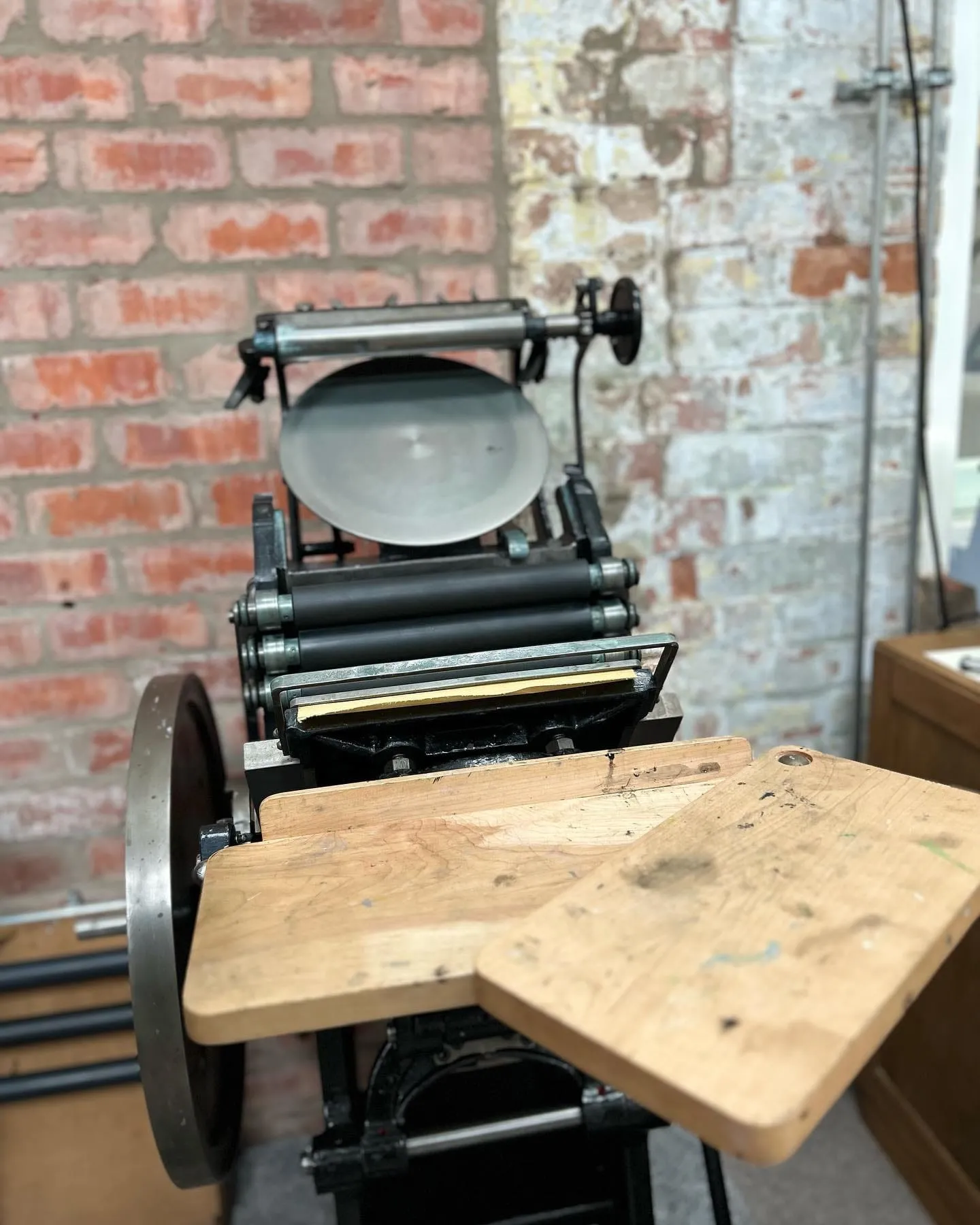
We print it on a Gem No1 platen letterpress, which joined the studio in 2023 and lives against the brick wall at Makers’ Yard. It is hand-fed: an ink disc at the top, rollers that carry ink down to the plate, a flywheel, and two wooden feed boards worn smooth by use. One pull, one sheet.
We print on uncoated cotton papers, usually between 300 and 600gsm, sometimes two sheets duplexed together to give enough depth for a really pronounced impression. Cotton has no wood fibre in it, so it is softer than a standard board and it takes the plate far better.
Ink is mixed by hand for each job. That is why letterpress colours look slightly different from anything a digital press would give you, and why we ask for a physical sample rather than a screenshot when you want us to match something.
What it goes well with
- Hot foil on the couple's names
- Deckle-edged cotton stock
- Hand-torn silk ribbon
Questions about letterpress
How deep should the impression be?
Deep enough to feel clearly, not so deep that it shows through the back of the sheet or distorts fine detail. On a 600gsm cotton stock we aim for an impression you notice the moment you run a finger over it. Very fine lines and small type limit how far we can go, because a heavy impression on thin strokes closes them up. We will show you a printed proof so you can feel it before we run the full quantity.
Why is letterpress more expensive than digital printing?
Each colour needs its own plate and its own pass through the press, and every sheet is fed by hand. A two-colour letterpress invitation is two full passes through a machine that prints one sheet at a time. You are paying for the plates and the hours, not the paper. It is why letterpress makes most sense for the invitation itself, and why many couples pair it with simpler printing for the inserts.
Can you match a specific colour?
Yes. Letterpress ink is mixed by hand, so we can work to a Pantone reference or to a physical sample such as a ribbon or a swatch of your bridesmaids' fabric. Send us the actual object where you can. Colour on a screen is not colour on paper, and cotton stock will always soften a shade slightly.
Thinking about letterpress?
Tell us about your wedding and we will send samples of the finishes you are considering, so you can judge them in your hand rather than on a screen.